HomeInsights › Weight and Muscle
Weight and Muscle

Two Official Protein Numbers. Which One Applies to You?

The 2026 guidelines say 1.2–1.6 g/kg. The RDA still says 0.8, unchanged since 2005. A physician on why both numbers exist, and which one is yours.

Jay
M.D., Seoul National University College of Medicine
August 21, 2026 · about 6 min read
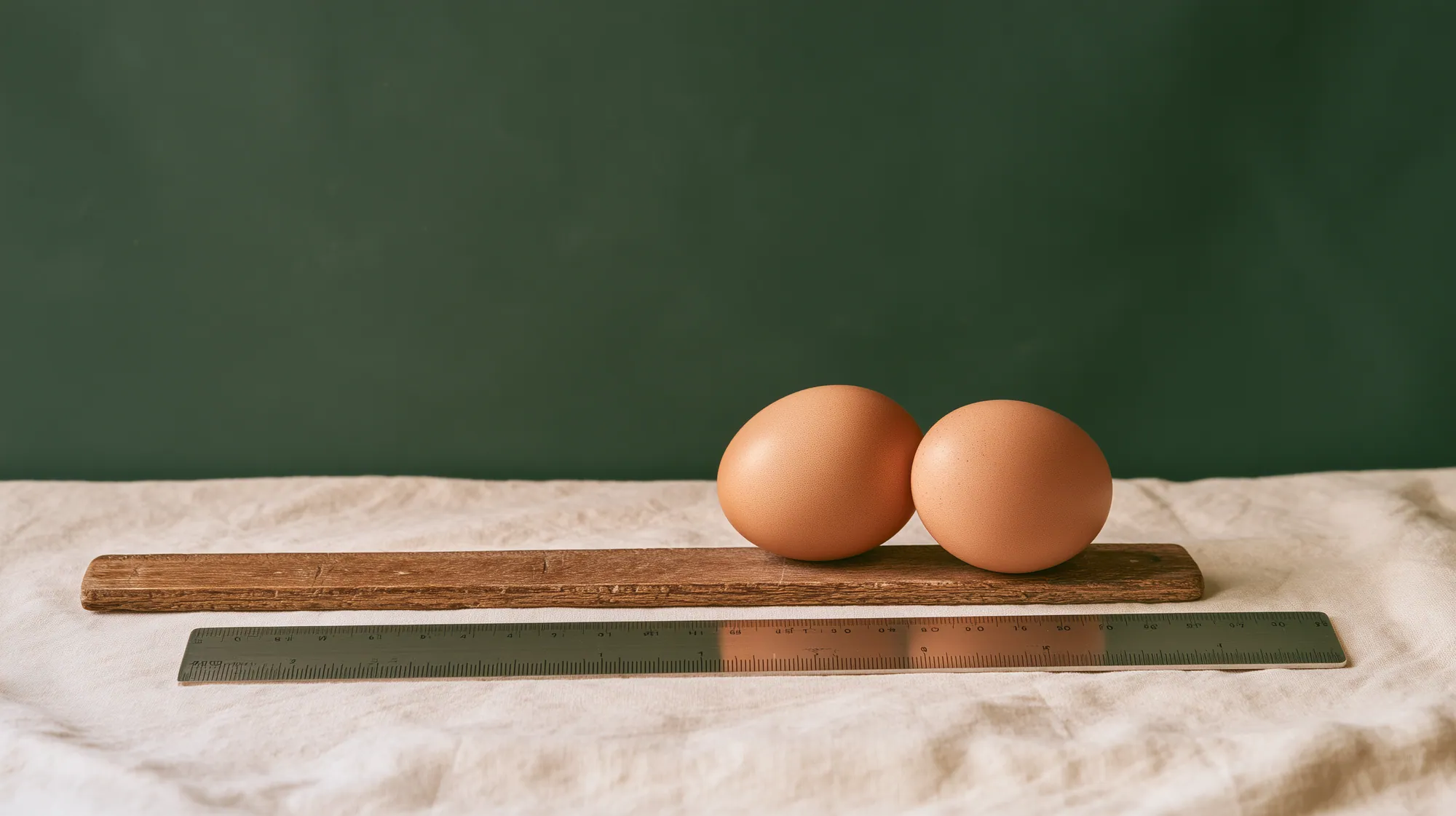
Two brown eggs resting on an old worn wooden ruler, with a marked steel ruler lying beneath it, on cream linen against a deep green wall
The question never changed. The ruler did.
Key takeaways
  1. Body weight in kg × 1.2 to 1.6 = daily protein grams. Aim high if you train, cut calories, or are over 60.
  2. The old 0.8 g/kg was a floor against deficiency, measured with a method that reads low. Re-measured, that floor lands near 1.2.
  3. Extra protein adds muscle only up to about 1.6 g/kg — and only alongside resistance training.
  4. Swap, don't stack. Protein piled onto an already-adequate diet is just extra calories — and over months, extra weight.
  5. Muscle building switches on around 20 to 25 g in a single meal — for most people the missing meal is breakfast.

Two federal numbers describe how much protein you should eat. They do not agree.

For a 70 kg adult, that is 56 g a day versus 84 to 112 g — one to two meals' worth of protein between the two answers.

Most coverage treated this as an update: the advice went up. That is not quite what happened. The old number is still there, still official. The new one simply appeared beside it.

The Short Answer

Use 1.2 to 1.6 g/kg as your target. Aim for the top of that range if you lift, are losing weight, or are over 60.

The RDA of 0.8 is not wrong. It answers a different question — what amount keeps nearly everyone out of deficiency. That is a floor, and it was never meant to be a goal.

How the old number was measured

There is a second reason these numbers differ, and it is the more interesting one: the floor itself was probably measured too low.

Start with how you would measure "enough" at all. If you eat less protein than you lose, your body breaks down its own muscle to cover the gap. If intake matches losses, you are covered. So researchers fed people different amounts and looked for the intake where the two sides matched — a method called nitrogen balance, since nitrogen is how protein gets counted. That balance point came out at 0.8.

The problem is the losses side. The studies collected urine and stool — but protein also leaves in shed skin, lost hair, and sweat, which nobody can collect. It is the household-budget mistake: count the card payments, miss the auto-drafting subscriptions, and a smaller income looks like enough. Losses looked smaller than they were, so "enough" landed lower than it really is. (A second bias in the analysis leaned the same way — PMID 17921376.)

What happened when they re-measured it

A newer technique starts from how the body actually uses protein. Building anything out of it — muscle, enzymes, skin — requires every amino acid the blueprint calls for, and the body keeps no storage bin for spares. A building block that cannot be used is burned for energy, and what is burned leaves in the breath as carbon dioxide.

That burning can be watched. Researchers put a trace tag on one amino acid and measure the breath. Feed too little protein and construction stalls — the tagged block goes unused, gets burned, and the tag shows up in the breath. Feed more and the burning drops, until adding protein stops changing it. The intake where the burn stops falling is "enough." The method is called indicator amino acid oxidation (IAAO).

Re-measured this way, "enough" came out at 1.2 g/kg — 50% higher than the old floor (The American Journal of Clinical Nutrition, 2007, PMID 17921376). Which means the lower bound of the 2026 target is not a new ambition; it is the old deficiency question, answered with a better ruler.

Why two numbers exist at all

Because two different bodies published them, for two different purposes, and only one of them moved.

Number Set by Asks
RDA 0.8 g/kg National Academies, 2005 What prevents deficiency in nearly everyone?
Dietary Guidelines 1.2–1.6 g/kg HHS and USDA, 2026 What protects lean mass during weight loss?

The government's own 2026 review calls the RDA a deficiency floor and puts actual US intake at about 1 g/kg a day — above the floor, below the new target. That is why "Americans already eat enough protein" and "Americans need more" are both true: each side measures against its own number.

Two Official Protein Numbers on One Line A horizontal number line of daily protein in grams per kilogram of body weight, from 0.6 to 1.8. A solid marker at 0.8 is labeled the RDA floor, set in 2005 and unchanged. A dot at about 1.0 marks actual average US intake — above the floor, below the target. A shaded band from 1.2 to 1.6 marks the 2026 Dietary Guidelines target. A dashed marker just past the band at 1.62 marks where muscle benefit flattens in resistance-training trials. 2026 Guidelines target 1.2 – 1.6 0.6 0.8 1.0 1.2 1.4 1.6 1.8 grams of protein per kg of body weight, per day → RDA floor set 2005, unchanged actual US intake about 1.0 muscle benefit flattens — 1.62
The whole disagreement on one line. Average US intake sits above the floor and below the target, so "enough" and "more" are both true — each against its own number. The dashed mark on the right is where muscle benefit flattens in training trials. Positions to scale.

The 1.2–1.6 range itself came from trials of mostly overweight adults during weight loss, where extra protein preserved muscle and sped up fat loss. A specific situation — and the target drawn from it now addresses everyone.

One more thing: that review never cites the re-measurement work (PMID 17921376). The strongest reason to think the floor was too low plays no part in the case for raising it.

Does more protein mean more muscle?

Only up to a point, and only alongside training.

A large meta-analysis of resistance-training trials found that extra protein does add strength and muscle — and that the benefit flattens at about 1.62 g/kg (PMID 28698222). The government's upper bound sits at 1.6. The ceiling is not arbitrary.

The condition matters as much as the number. Protein is permissive, not causal — it supplies the material; training supplies the signal. Raising intake without lifting does not produce these results, a point that also holds for muscle during rapid weight loss on GLP-1 medication.

What This Means for You

How much. Your weight in kilograms × 1.2 is the lower target; × 1.6 is the upper. Aim high in three cases: training, a calorie deficit, or age over 60.

How to add it — this is the trap. Protein carries calories, about 4 per gram. Stack a shake on top of meals that already covered your day, and the protein goal is met while the day quietly gains 300 calories. Months of that is weight gain — the opposite of the point. So swap instead of stack: half the rice comes off the plate, two eggs go on. Same calories, more protein. The guideline's own bullet ends with exactly this adjustment — the half of the sentence nobody quotes.

When. The muscle-building response has an on-switch, and one meal needs roughly 20 to 25 g to flip it — more as you age (PMID 29497353). Ninety grams at dinner flips the switch once; thirty at each meal flips it three times. For most people the empty meal is breakfast.

Watching only protein hides the trap. "98 g today" reads the same whether it came from rearranging the plate or from stacking 300 calories on it. Only the calorie line next to the protein line tells those apart — which is why Vivledia draws both against their targets on one screen. The wider habits still outrank the macro: for most people, sleep and daily movement move the needle further than any gram target.

Where these numbers come from

Study What it looked at What it found
Am J Clin Nutr 2007 (PMID 17921376) Protein requirement re-measured by IAAO in young men Average 0.93 g/kg, population-safe 1.2 g/kg — 41% and 50% above the nitrogen-balance figures
Br J Sports Med 2018 (PMID 28698222) 49 trials, 1,863 adults, protein plus resistance training Strength and lean mass improved; the benefit flattened at about 1.62 g/kg
J Nutr 2018 (PMID 30383278) 28 trials, 1,358 participants, kidney filtration No difference between higher- and normal-protein diets in healthy adults
Br J Nutr 2003 · 2023 (PMID 12908885, PMC10167660) The case against IAAO: readings taken within hours may run high The bias is real but small — several times too small to close the gap back to 0.8

The first row is the engine of this article: it is why the floor and the new lower bound landed on the same number. The last row is the counterweight — measured, found small, not settled.

This article is general health information, not medical advice. Protein needs differ by person — if you have kidney disease, are pregnant, or are managing a diagnosed condition, your own clinician's target replaces the arithmetic here.


Frequently asked questions

So how much protein should I actually eat?

Take your weight in kilograms and multiply by 1.2 for the lower end of the new target, or 1.6 for the upper end. A 70 kg adult lands at 84–112 g a day; a 60 kg adult at 72–96 g. Three situations argue for the upper end — resistance training, an intentional calorie deficit, and age over 60 — because that is where the evidence for more protein is strongest. Everyone else can sit lower in the range. If you have kidney disease, this arithmetic does not apply to you and your clinician's target does.

If the RDA is still 0.8, does that mean the new number is wrong?

No — it means the two numbers were built to answer different questions. The RDA is a floor: the amount that keeps almost everyone out of deficiency. The Dietary Guidelines target is aimed at function, mainly holding on to lean mass during weight loss. A floor and a target were never going to be the same number. What is fair to say is that the higher number rests on a narrower evidence base, which is exactly what several nutrition researchers have objected to.

Can I just add a protein shake to hit the target?

You can, but watch what it does to your daily total. A shake bolted onto an already-adequate diet contributes calories as well as grams, and across months that can push your weight in the direction you did not intend. The guideline does attach a caveat — it tells you to adjust for your own calorie needs — but that clause sits at the end of a bullet whose headline is a gram figure, and critics argue it is the gram figure people act on. Swapping is the cleaner move — let the protein displace something else at the same meal.

Does it matter how I spread protein across the day?

Somewhat, and more with age. The muscle-building response is triggered by a threshold-sized serving, and that threshold rises as you get older — a phenomenon called anabolic resistance. Reviews of the distribution literature land near 20–25 g for young adults, with a higher figure for older ones (PMID 29497353). In practice the fix is usually breakfast, which is where most people's protein is thinnest.

Is a high-protein diet hard on the kidneys?

In healthy adults, the evidence does not support that concern. Pooling 28 trials and 1,358 participants, researchers found that filtration rate tracked the same whether people ate more protein or less (PMID 30383278). The qualifier doing the work is "healthy" — that research excluded people with kidney disease, for whom protein targets are a clinical decision rather than a general-advice one.

Share X Reddit
References
  1. Humayun MA, et al. Reevaluation of the protein requirement in young men with the indicator amino acid oxidation technique. The American Journal of Clinical Nutrition. 2007. PMID: 17921376
  2. Morton RW, et al. A systematic review, meta-analysis and meta-regression of the effect of protein supplementation on resistance training-induced gains in muscle mass and strength in healthy adults. British Journal of Sports Medicine. 2018. PMID: 28698222
  3. Devries MC, et al. Changes in kidney function do not differ between healthy adults consuming higher- compared with lower- or normal-protein diets. The Journal of Nutrition. 2018. PMID: 30383278
  4. Millward DJ. An adaptive metabolic demand model for protein and amino acid requirements. British Journal of Nutrition. 2003. PMID: 12908885
  5. Amino acid oxidation methods to determine amino acid requirements: do we require lengthy adaptation periods? British Journal of Nutrition. 2023. NCBI PMC10167660
  6. Perspectives on the Protein Recommendations in the 2025–2030 Dietary Guidelines for Americans. The Journal of Nutrition. 2026.
  7. Schoenfeld BJ, Aragon AA. How much protein can the body use in a single meal for muscle-building? Implications for daily protein distribution. Journal of the International Society of Sports Nutrition. 2018. PMID: 29497353
  8. Institute of Medicine. Dietary Reference Intakes for Energy, Carbohydrate, Fiber, Fat, Fatty Acids, Cholesterol, Protein, and Amino Acids. The National Academies Press. 2005. NAP record 10490
  9. U.S. Department of Health and Human Services and U.S. Department of Agriculture. Dietary Guidelines for Americans, 2025–2030. Protein serving goals, p.1. https://cdn.realfood.gov/DGA_508.pdf
  10. The Scientific Foundation for the Dietary Guidelines for Americans, 2025–2030, pp.36–37 — RDA basis, average US intake, and the 30-trial systematic review. https://cdn.realfood.gov/Scientific%20Report_508.pdf
This content is for general informational purposes only and is not medical advice. It is not intended to diagnose, treat, cure, or prevent any disease, and it is not a substitute for care from a qualified healthcare professional. Always consult your clinician about specific symptoms, conditions, or before changing medications.
Jay
Jaeyoung Ko, M.D.
M.D., Seoul National University College of Medicine

A physician trained at Seoul National University College of Medicine. Starting from the question of why health matters and what aging really is, he builds Vivledia — an app for logging daily health habits and managing the pace of aging.

Get the next one by email

New evidence-based pieces on slow aging, screenings, and nutrition — sent when they publish. No spam, no sharing your address, unsubscribe any time.

By subscribing you agree to receive occasional emails from us. We store only your address, and never sell or share it. See our Privacy Policy.

Your multivitamin has zinc. So does your zinc.

Photograph your labels — Vivledia totals every ingredient you take and flags what crosses the upper intake limit.

All insightsEN한국어© 2026 Vivledia