"I lost 8 kg in two months."
Ozempic, Wegovy, Mounjaro, Zepbound. A few years ago these were words you heard in an endocrinology clinic. Now they come up at dinner tables, in group chats, at the office. Almost everyone knows someone who is on one, or thinking about it.
This article is not an argument for or against taking one. That decision belongs to you and your prescribing clinician, who know your medical history, your other medications, and your risks. It is not something an article can decide.
The question I want to ask is a different one. When someone says 8 kg (about 18 lb) came off, what was that 8 kg made of?
The Short Answer
Body composition trials do not show GLP-1 drugs singling out muscle. In the largest study (tirzepatide, 72 weeks), about 75% of the weight lost was fat and 25% lean mass — a ratio similar to placebo. The "40% is muscle" figure traces to a 140-person substudy. Resistance training plus adequate protein (1.2–1.6 g/kg/day) is what protects muscle.
A scale cannot answer that. And from the standpoint of how fast you are aging, the answer changes what the same 8 kg means.
What do you actually lose when you lose weight?
Let me clear up one misconception first.
Weight does not come off as pure fat. The body is not built to burn fat selectively. When energy runs short for long enough, fat goes — and so does some of everything else.
Research calls that everything else lean mass: all the tissue that is not fat, meaning muscle, water, bone, and organs. Body composition studies measure two blocks, fat and lean, so the term will keep coming up.
One thing is worth holding onto. A drop in lean mass is not the same as that much muscle disappearing. Early in weight loss, a large share of the lean mass that goes is water. Stored carbohydrate holds water alongside it, so when those stores are drawn down, the water leaves too. The dramatic first-week drop on the scale is mostly that.
And losing fat and lean mass together is not a property of any particular drug. It is a property of losing weight. Crash dieting, training hard, taking a medication — the pattern holds. So "this medication makes you lose muscle" is half a sentence. The full one is closer to: losing weight costs some muscle, and these medications help people lose a lot of weight.
The question worth asking is not whether muscle goes. It is how much.
How much lean mass is lost on these medications?
The largest and most recent answer comes from the SURMOUNT-1 body composition study of tirzepatide (Mounjaro, Zepbound), published in Diabetes, Obesity and Metabolism (Look et al., 2025, PMID 39921715). Participants were followed for 72 weeks, with DXA scans measuring what their bodies were made of.
- Fat mass: down 33.9% in the treatment group, 8.2% in the placebo group
- Lean mass: down 10.9% in the treatment group, 2.6% in the placebo group
That 10.9% is the figure that catches the eye. But set the total weight lost at 100, and the split was roughly three quarters fat, one quarter lean.
Here is the part that decides the interpretation. That ratio was similar in the placebo group.
In other words, the picture where the medication singles out muscle is not in this data. The proportion held steady while the total grew, so the absolute lean mass figure grew with it.
That distinction sounds small and it decides everything. The first reading leads to "don't use these drugs." The second leads to "when you lose a lot, protect what you don't want to lose." The evidence points to the second.
So where did "40% of it is muscle" come from?
For a while one sentence circulated everywhere: 40% of the weight lost is muscle.
Follow it back and you land on an exploratory analysis of the STEP 1 semaglutide (Ozempic, Wegovy) trial (Wilding et al., Journal of the Endocrine Society, 2021). Of 1,961 participants, 140 had DXA scans. In that subset, lean mass fell 9.7%.
The same presentation contained something else. Lean mass as a share of body weight actually rose by 3.0 percentage points. Read the absolute numbers and you get "nearly 10% of muscle gone." Read the proportions and you get "muscle makes up more of the body than before." Both are the same finding from the same study.
Reviews report lean mass loss anywhere from 15% to 40% of total weight lost, depending on the study. Measurement methods, participant age, and rate of loss all differ.
When one number gets quoted far more than the rest, it is worth asking whether it is the most accurate one or simply the most alarming one.
A calculation from a 140-person substudy circulating as a fact about millions of people is more common in health coverage than it should be.
Does losing lean mass mean sarcopenia?
Muscle mass and muscle function are not the same thing. Sarcopenia is not a label applied on mass alone; it requires reduced strength or physical function as well. If muscle mass drifts down but strength and movement hold, that is a change in body composition, not a diagnosis.
The SEMALEAN study (Diabetes, Obesity and Metabolism, 2026, PMID 39410872) shows why the distinction matters. Among 106 people taking semaglutide followed for 12 months, lean mass fell 3.0 kg through month seven and then stopped falling. Grip strength, meanwhile, improved by 4.1 kg at 12 months, and the share classified as having sarcopenic obesity fell from 49% to 33%.
Less muscle but more strength sounds contradictory, though it is not hard to explain. When body weight drops by close to 20 kg, knees and lower backs carry less, and moving gets easier. Moving puts muscle back to work.
That study had no control group, and people who discontinued treatment dropped out of the analysis — which means the results may reflect the people who did well. So it is not evidence that a medication makes you stronger. Read it more narrowly: a drop in muscle mass should not be translated straight into a loss of function.
What is actually worth worrying about?
You might conclude from all this that there is nothing to worry about. From the standpoint of how fast you are aging, there are three places I would still pay attention.
First, the leaner you already are, the worse the trade. A body with ample fat draws more of the deficit from fat; a body with little fat to give draws more from everything else. This has been described in the physiology literature for decades (Forbes, Annals of the New York Academy of Sciences, 2000, PMID 10865771).
Second, it gets harder to reverse with age. Lost fat, unfortunately, comes back readily. Lost muscle does not return on its own, and after midlife, muscle responds less to the same training stimulus.
Third, stopping. In the STEP 1 extension study (Wilding et al., Diabetes, Obesity and Metabolism, 2022, PMID 35441470), which followed participants for a year after 68 weeks of treatment, they regained about two thirds of the weight they had lost. How that regained weight divides between fat and lean mass has not been measured at scale, so nobody can claim that "you lose muscle on the way down and gain fat on the way up." What is fair to say is that there is no particular reason to expect repeated cycles of loss and regain to be good for body composition.
Put together, the risk the current data describes is not that a drug dissolves muscle. It is what a body is made of after weight comes off with nothing else in place.
What protects muscle during weight loss?
The weight of evidence changes a little from here. How body composition shifts was measured directly in trials. What helps is mostly borrowed from research done in other settings. Read this section with that in mind.
Resistance training — prevents much of the loss
This is the best-supported piece.
A meta-analysis of six randomized trials in Nutrients (Sardeli et al., 2018, PMID 29596310), in older adults with obesity on calorie-restricted diets, found that the diet-only groups lost an average of 1.58 kg of lean mass, while the groups that added resistance training lost 0.76 kg. A large share of the loss simply did not happen.
Resistance training here does not mean a gym membership. It means movement that puts more than everyday load on a muscle. Squats, push-ups, bands, dumbbells, stairs. When energy is low because you are eating less, holding onto frequency and repetitions is more realistic than chasing heavier loads.

There is also direct evidence in the context of medication. In a randomized trial in the New England Journal of Medicine (Lundgren et al., 2021, PMID 33951361), 195 people who had lost weight on an eight-week low-calorie diet were split into four groups and followed for a year. The group that did nothing regained 6.1 kg, the medication-only group held roughly steady, and the group that combined exercise with medication lost a further 3.4 kg.
The difference in body fat percentage was starker. The combination group dropped 3.9 percentage points, roughly twice the change seen with exercise alone or medication alone. And the combination group was the only one where hemoglobin A1c, insulin sensitivity, and cardiorespiratory fitness improved together.
The same change on the scale leaves a different body behind depending on what it was paired with.
Protein — protecting the total
While losing weight, most reviews suggest aiming higher on protein than usual, commonly citing a range of 1.2 to 1.6 g per kg of body weight per day. At 60 kg (about 132 lb), that is roughly 72 to 96 g a day.
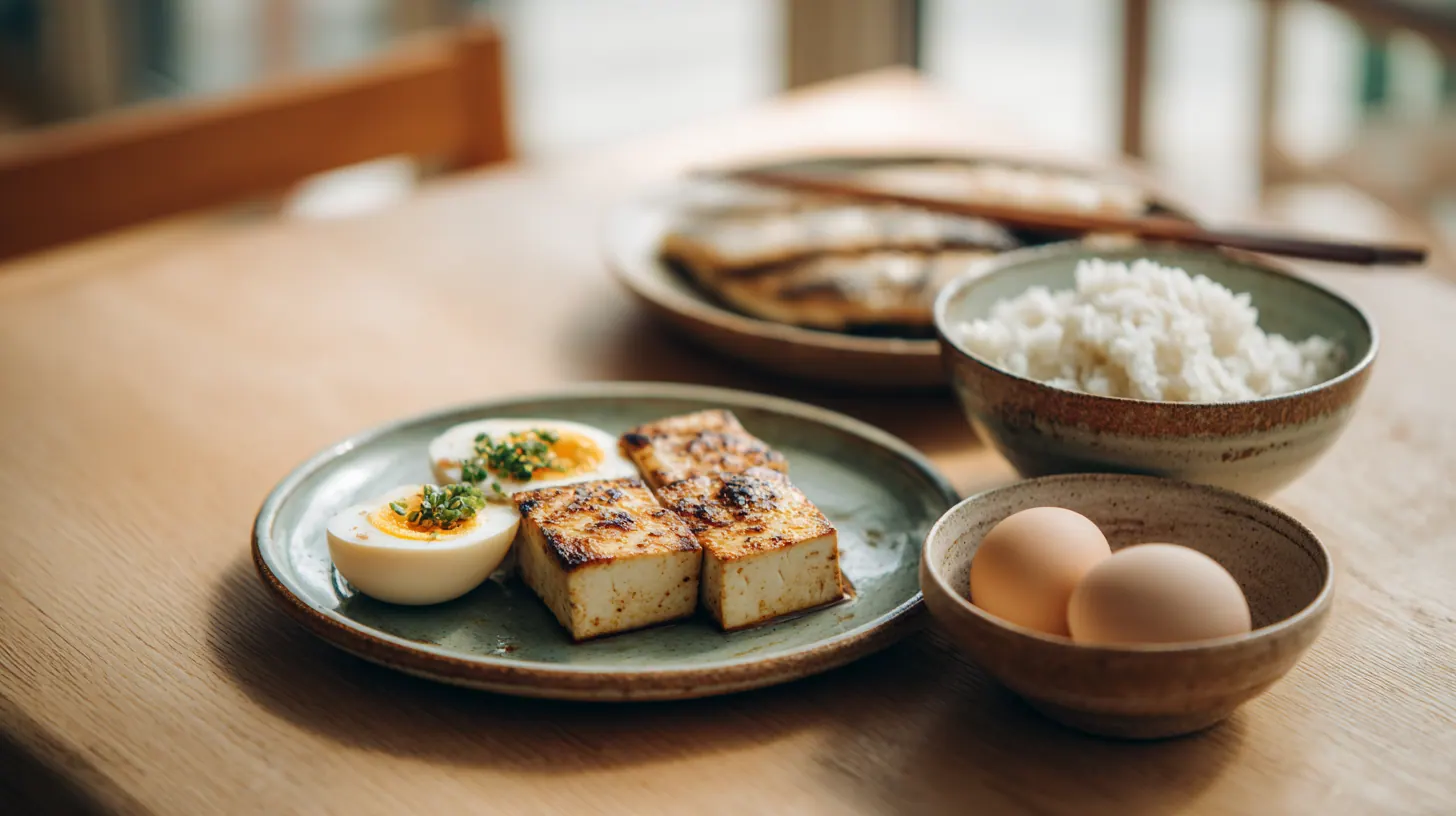
The complication is that these medications reduce how much you eat overall. Reduced appetite is how they work, so that is expected — but when the total shrinks, protein is often the first thing cut. Rice and soup go down out of habit; the fish or the tofu gets left on the plate because it does not appeal.
So the practical move is less about adding and more about reordering. Eating the protein on the plate first, before anything else, changes the daily total on its own.
This recommendation does not apply as written to people with kidney disease. If that describes you, talk to your own clinician before changing your protein intake.
Tracking — what the scale cannot see
Back to where this started. A scale tells you how much came off. It never tells you what came off.
So while losing weight, you need something to watch besides the number. This is not about special equipment. How many times you did strength work this week. How many meals a day contained real protein. Whether climbing stairs or standing up out of a chair feels different than it used to. Those three alone cover much of what a weight graph misses. (If drinking is part of your week, it belongs in the picture too — alcohol works directly against muscle recovery.)
The gap between who is taking these and who is training
It is worth looking at who actually fills these prescriptions. In South Korea, where I practice, monthly prescriptions for one of these products passed 270,000 in May 2026 and 1.5 million cumulatively; another product has passed 1.2 million. The largest age group is people in their thirties, and those in their twenties and thirties together make up more than half (Yonhap News, July 2026, based on Health Insurance Review & Assessment Service DUR data).
The exercise habits of those same age groups tell a different story. In an analysis of more than 3.1 million people who underwent national health screening, 43.4% did not meet World Health Organization physical activity recommendations. Only 23.0% did both aerobic and strength work; another 8.2% did strength work alone (KMI Health Checkup Big Data series, 2022–2025, reported June 2026). Add those together and strength training is part of life for about three people in ten.
Weight loss is the hardest phase in which to hold onto muscle. Going through that phase with no strength training habit means the scale can hit its target while the composition of the body ends up worse than when you started.
One more caveat. Trial participants were, for the most part, well above the threshold for obesity. Given the principle above — the less fat there is to give, the more the deficit comes from everything else — these numbers do not transfer cleanly to someone who was not carrying much extra weight to begin with.
When to see a clinician
If any of the following applies, please do not sort it out alone. Bring it to a clinician.
- Climbing stairs or standing up from a chair feels harder than it used to
- Your grip on objects or your walking speed has noticeably changed
- Dizziness, severe fatigue, hair loss, or menstrual irregularity — signs that weight is coming off faster than your body is keeping up with
- You have kidney disease, liver disease, or osteoporosis, or have been told you may be at risk for any of them
- You are 65 or older, or have previously been assessed as having low muscle mass
- Nausea or vomiting has cut your food intake so far that you have not eaten properly for days
Anything involving a prescription — starting, adjusting, or stopping — is a conversation with your prescribing clinician, not something to work out from an article.
One more number changes the picture
Weight is an easy number to manage. You can measure it in the same spot every day, the movement shows up immediately, and it makes for a clean goal. Which is exactly why, during weight loss, that one number tends to crowd everything else out.
But as we have seen, that number does not tell you what came off. From the standpoint of how fast you are aging, what matters is not how many kilograms disappeared but what stayed behind.
Vivledia puts weight, food, and movement on the same screen. When you can see how many days you trained and how many meals had protein in them running alongside the weight graph, the basis for judging whether things are going well goes from one number to three. Two of the four axes described in slow aging meet right here.
Medication or not, losing weight is ultimately a change in what your body is made of. That being the case, it is worth knowing what is changing.