
You know the feeling before a presentation you are dreading. Not nerves in your head — nerves in your stomach. And when a decision is too big for the spreadsheet, we call it a gut feeling — never a brain feeling.
That phrasing is not an accident of language. There is a real sense in which the body thinks below the ribs. The intestine runs its own nervous system, is wired to the brain by a dedicated line, and houses roughly 100 trillion microbes that manufacture compounds circulating through the entire body.
The Short Answer
The gut runs its own nervous system of roughly 500 million neurons — the enteric nervous system, or "second brain." It talks to the brain through the vagus nerve, immune signals, and microbial metabolites. The best-evidenced habit for gut health is eating more fiber from diverse plants: 30 or more plant foods a week are linked to measurably higher microbial diversity.
That is why the gut keeps turning up in research on aging, immunity, and mental health. Here is what the second brain label actually refers to, what gut health does and does not determine, and what is worth changing this week.
Does the Gut Really Have Its Own Nervous System?
It is easy to picture the intestine as plumbing — a long tube food travels through. But woven into the intestinal wall is an independent network called the enteric nervous system. Estimates put the number of neurons in it at roughly 500 million, comparable to the entire brain of a cat (Furness, Nature Reviews Gastroenterology & Hepatology, 2012, PMID 22392290).
The more striking part is that this network runs without instructions from above. When food arrives, the gut reads the situation on its own: it fires muscle contractions in sequence, decides how much digestive fluid to release, and adjusts the pace of absorption. Sever the connection to the brain and the gut keeps doing all of it. Almost no other organ in the body has that kind of autonomy.
That autonomy is why neuroscientists call the enteric nervous system a second brain. It is less a metaphor than a description of the wiring.
How Do the Gut and Brain Communicate? The Vagus Nerve
The gut and the brain are not strangers. The thickest cable between them is the vagus nerve, which runs from the brainstem down through the neck and chest into the abdomen — the longest reach of any nerve in the body.
Here is the part that surprises most people. The traffic on that cable is lopsided, and it is not lopsided in the direction you would guess. The great majority of vagal fibers are sensory: they carry reports upward, from body to brain, not commands downward.
In other words, the gut is not an organ awaiting orders. It is an organ filing status reports, continuously. What just arrived, how the barrier is holding up, what the resident microbes are producing — all of it gets relayed north.
And the vagus nerve is not the only channel. The gut speaks to the brain in three languages at once.
| Channel | How the message travels |
|---|---|
| Neural | Direct signaling along the vagus nerve — the fastest line |
| Immune | The gut hosts more immune cells than anywhere else in the body; inflammatory signals generated there enter circulation |
| Metabolic | Microbial metabolites and gut-derived hormones ride the bloodstream to the brain |
Collectively these three routes are called the gut-brain axis. The stomachache that shows up with stress, and the flat mood that shows up with digestive trouble, are those lines doing their job.
Is 90 Percent of Your Serotonin Really Made in the Gut?
One claim shows up in nearly every gut health article: more than 90 percent of the body's serotonin, the so-called happiness molecule, is made in the gut.
The claim itself is accurate. Most of the serotonin in the body is produced by cells in the intestine rather than in the brain, and a study in Cell (Yano et al., 2015, PMID 25860609) showed that resident gut bacteria influence how much of it gets made.
The trouble starts one step later, with the conclusion people draw: fix the gut and you will feel happier. Stated plainly, that is an overreach.
Serotonin made in the gut does not cross into the brain. The blood-brain barrier is selective about what it admits, and serotonin is not on the list. Gut serotonin mostly does local, bodily work — motility, platelet function, digestive regulation.
Does that mean the gut has nothing to do with mood? No. It means the route is different. Rather than serotonin taking a shortcut across, the gut influences brain state through the three detours above: neural, immune, metabolic. The connection is real. The shortcut is not.
The distinction sounds like a technicality. It is not. It is usually the exact line separating evidence from marketing in this field.
What Does the Gut Microbiome Actually Do?
If the enteric nervous system is the hardware, the drama of gut health is written by what lives inside.
Estimates of the bacteria in the human gut range from tens of trillions to around 100 trillion, spanning hundreds to over a thousand species. Their combined genes vastly outnumber our own. Researchers sometimes call the whole community the forgotten organ — a kilogram or two by weight, but functionally closer to an organ than to cargo.
These are not passengers. They work.
- They break down fiber we cannot digest and convert it into energy and useful compounds
- They produce vitamin K and several B vitamins
- They occupy space and consume nutrients, leaving less room for problem organisms to expand
- They train immune cells, tuning them away from overreaction
Which brings up the central concept: diversity. Having a lot of one good bug appears to matter less than having many species present in reasonable balance. It is the logic of any ecosystem. A forest with many species rides out drought and pests better than a monoculture, and a diverse microbial community appears more resilient to disruption.
What Are Short-Chain Fatty Acids — and Why Do They Matter?
Of everything the microbiome does, the piece drawing the most attention lately is short-chain fatty acids, or SCFAs (Koh et al., Cell, 2016, PMID 27259147). The name is clinical; the idea is simple.
We cannot digest fiber. It passes through the stomach and small intestine essentially intact. When it reaches the colon, the microbes there ferment it and produce short-chain fatty acids, butyrate among them.
What those compounds do is remarkable.
- Butyrate is the primary fuel for colon cells. The cells lining your colon prefer it over glucose from the blood. You feed the microbes; the microbes feed the cells of your own barrier.
- SCFAs are involved in maintaining tight junctions between the cells of the gut lining.
- They modulate immune activity in an anti-inflammatory direction.
- Once in circulation, they appear to participate in metabolic and appetite regulation as well.
The chain looks like this:
Fiber → microbial fermentation → short-chain fatty acids → a better-maintained barrier and lower inflammatory signaling
That chain explains why eat more fiber, an old and unglamorous piece of advice, is still frontline advice. Fiber is less a nutrient for you than food for your microbes, and what they return for it is upkeep on your intestinal wall.
What happens when fiber runs short? Research suggests some species, deprived of their usual food, start grazing on the mucus layer lining the gut instead. The wall gets thinner.
Is "Leaky Gut" Real? The Wall That Is One Cell Thick
Worth pausing on the architecture here.
What separates the inside of your intestine from the inside of your body is a single layer of cells. On one side of that thin wall sit your food and 100 trillion bacteria. On the other side sit blood vessels and immune cells. By surface area, this is the largest interface your body has with the outside world.
The wall is not meant to be a sealed one. It has to admit nutrients and refuse trouble, so the junctions between cells are built to loosen and tighten depending on conditions. When that regulation drifts, material that should have stayed out can cross, and the immune system may read the crossing as an intrusion — a plausible route to persistent low-grade inflammation.
Online, this gets marketed as leaky gut syndrome. This is where an honest line has to be drawn.
Changes in intestinal permeability are a legitimate area of study, and their relationship to various conditions is under active investigation. But leaky gut syndrome is not an established diagnosis, and most claims that a specific test or supplement can identify and correct it rest on thin evidence.
The concept is real; the sales pitch built on it usually is not. Holding those two apart is the single most useful skill for reading gut health content.
How Does Gut Health Affect Aging?
The reason the gut keeps appearing in longevity conversations comes down to inflammation.
With age, low-grade inflammation accumulates quietly even in the absence of any specific disease. Researchers call it inflammaging, and it has been linked to aging in blood vessels, muscle, and brain.
A meaningful share of that signal originates in the gut. When the barrier weakens, bacterial cell-wall fragments can trickle into circulation; a sustained immune response to them nudges systemic inflammatory markers upward. Microbially produced short-chain fatty acids push in the opposite direction.
So the gut sits close to the tap. That is why slow-aging advice and gut health advice keep converging — the same problem viewed through a different door.
What You Can Actually Do
That is the mechanism. Now the practical part. The encouraging news is that this is a high-leverage area: the composition of the gut microbiome is shaped far more by diet than by genetics, and measurable shifts can appear within days of a dietary change.
One, Hit the Fiber Number
Best-supported item on the list, and the one most people fall short on.
A series of systematic reviews and meta-analyses in The Lancet (Reynolds et al., 2019, PMID 30638909) found that people consuming roughly 25 to 29 grams of fiber a day or more showed consistently lower rates of cardiovascular disease, type 2 diabetes, and colorectal cancer — with the trend continuing upward at higher intakes. US guidance lands in similar territory: about 25 grams a day for women and 38 grams for men.
Reality falls well below that. Average intake among American adults sits around 15 grams a day, and a diet built on refined grains makes even that a stretch.
Fiber comes in two kinds with different properties, and you want both.
| Soluble fiber | Insoluble fiber | |
|---|---|---|
| Behavior | Dissolves in water, forms a gel | Does not dissolve; adds bulk |
| Role | Primary microbial food → SCFA production; blunts glucose and cholesterol responses | Adds stool bulk and keeps things moving |
| Found in | Oats, barley, beans and lentils, apples, seaweed | Whole grain bran, vegetable stalks, nuts, skin-on fruit |
The execution does not need to be dramatic. Swapping in barley or oats, adding one more vegetable to each plate, and moving snacks toward nuts and fruit can add close to 10 grams a day on its own.
One caution. Ramping up fast produces gas and bloating, because the microbial community needs time to adapt. Build up over a week or two, and drink enough water — fiber only does its job hydrated.
Two, Count Plants, Not Just Grams
This is the advice that has become sharpest in recent years: the number of different plants matters alongside the total grams.
Different microbes prefer different substrates. Eat an apple every day and you cultivate the apple specialists. Eat across many plant foods and many species each get something. Diversity on the plate produces diversity in the gut.
In the American Gut project, a citizen-science study spanning tens of thousands of participants (McDonald et al., mSystems, 2018, PMID 29795809), people eating more than 30 different plant foods per week had markedly higher gut microbial diversity than those eating 10 or fewer.
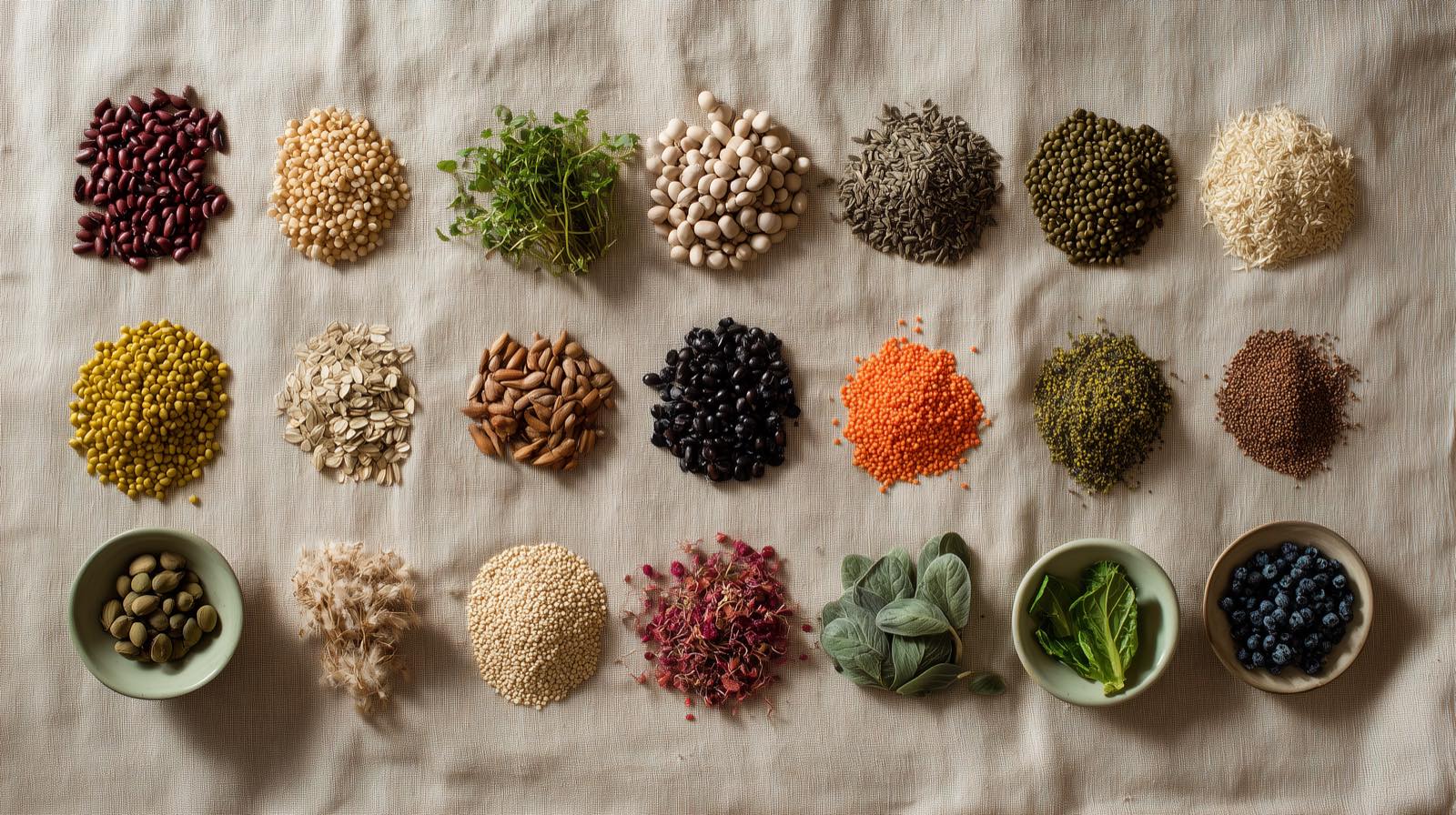
Thirty sounds like a lot until you see what counts. Not just vegetables and fruit, but whole grains, beans, nuts, seeds, herbs, and spices — each one counts as its own plant.
- A multigrain bowl = rice, barley, oats, sorghum, beans → five already
- Three vegetable side dishes = three
- A handful of mixed nuts = almonds, walnuts, cashews → three
- A jar of salsa = tomato, onion, garlic, cilantro, chili → five
Counted that way, 30 stops being a target and becomes a bookkeeping question. Cooking that leans on beans, herbs, and mixed grains gets there without effort.
Three, A Little Fermented Food Every Day
If fiber feeds the microbes already living in you, fermented food introduces new ones from outside, along with the compounds they produced along the way.
In a randomized trial in Cell (Wastyk et al., 2021, PMID 34256014), the group that increased fermented food intake showed rising gut microbial diversity within weeks along with a downward trend in several inflammation-related proteins. Interestingly, the high-fiber arm of the same study did not show that particular effect as clearly. The two do different jobs. They are a combination, not a competition.
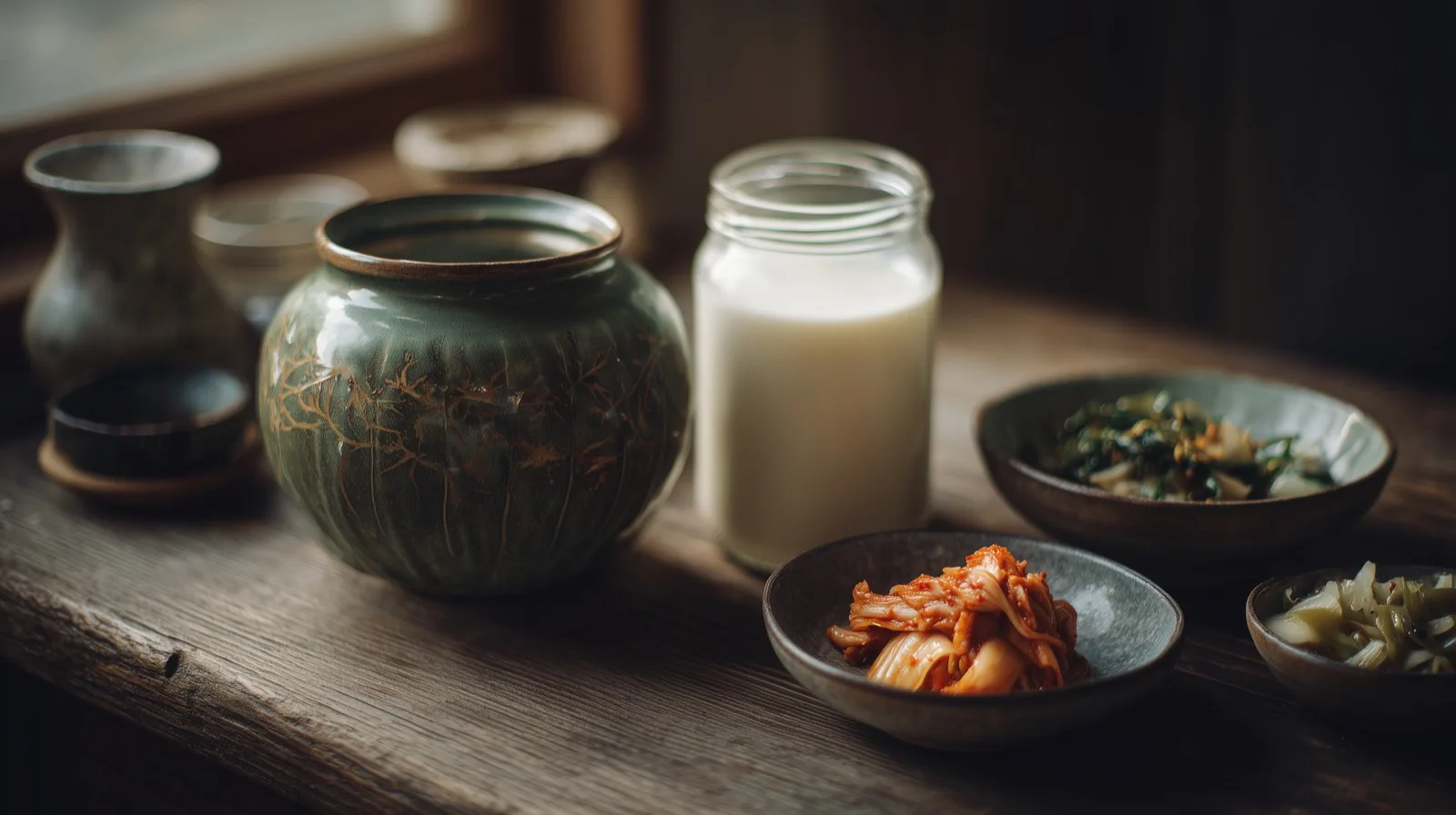
The menu is wide: plain yogurt, kefir, unsweetened sauerkraut, kimchi, miso, tempeh, natto, traditionally fermented pickles. Rotating through several beats committing to one.
One honest caveat. Many fermented foods carry substantial sodium. Doubling your kimchi for gut reasons is not a good trade against blood pressure. Widen the variety rather than the volume, and go easy on the salty brine.
Four, Subtract What Works Against You
What you remove counts as much as what you add.
- Ultra-processed food — very little fiber, so very little for the microbes to work with. The larger problem is what it displaces: the vegetables and whole grains that would have filled the same plate.
- Certain emulsifiers and artificial sweeteners — some emulsifiers used to keep processed foods smooth have been reported to affect gut microbes and the mucus layer in animal work and small human feeding studies (Chassaing et al., Gastroenterology, 2022, PMID 34774538). Nothing here is settled, but it is one more reason to lean away from labels with long lists of unfamiliar ingredients.
- Heavy drinking — alcohol works against both barrier function and microbial balance.
- Unnecessary antibiotics — antibiotics are essential drugs when they are indicated. They simply do nothing for viral illnesses like the common cold. Reports suggest microbial composition can take months to return toward baseline after a single course. This is not a case for stopping a prescription on your own; it is a case for not requesting one you do not need.
Five, The Gut Keeps Time
The gut is not in the same state around the clock. Even microbial composition and activity rise and fall on a daily cycle, which means a broken rhythm shakes the gut along with everything else.
Gaps between meals. The stomach and small intestine run a housekeeping wave that operates only when they are empty, sweeping residue and bacteria downstream. It stops the moment anything arrives. Grazing all day erases that cleaning window — part of why some people find that a longer overnight eating gap settles their digestion.
Sleep. Short or shifted sleep is reported to disturb microbial rhythms as well. A late-night meal disrupts the cycle twice over.
Movement. Regular exercise supports motility, and several observational studies find higher microbial diversity in people who exercise.
Stress. The gut-brain axis runs both ways. The stress response alters motility, permeability, and microbial composition. The stomach trouble that shows up during exam week is physiology, not imagination.
Do Probiotic Pills and Microbiome Tests Actually Work?
Two questions always come up. Straight answers.
Probiotics. There are settings where benefits have been reported. But effects are documented strain by strain and context by context. A trial showing one strain helped in one situation does not extend to everything on the shelf. Most strains pass through rather than colonizing, and things generally drift back when you stop. There is even research suggesting that after antibiotics, probiotics may slow the recovery of a person's original microbial community rather than speed it (Suez et al., Cell, 2018, PMID 30193113). None of this means do not take them. It means treat them as a layer on top of the foundation, which is fiber and fermented food.
Microbiome tests. Interesting reading, but too early to base a personalized prescription on. Results vary with collection timing and analysis method, and the evidence behind the food advice attached to a low reading on one organism is thin. Whatever the report says, the recommendation ends up much the same: more fiber, more kinds of plants.
Signs That Deserve a Doctor, Not a Diet
Everything above is lifestyle territory. Some gut symptoms are not lifestyle problems, and they warrant evaluation rather than a meal plan. If any of the following applies, see a clinician before you rework your diet.
- Blood in the stool, or black, tarry stools
- Unexplained weight loss
- A distinct change in bowel habits that persists for several weeks
- Abdominal pain or diarrhea severe enough to wake you at night
- Difficulty swallowing, or repeated vomiting
- Anemia alongside digestive symptoms
- A family history of colorectal cancer, or being due for screening and not having had it
The more gut health content there is, the more this principle matters. A good diet does not substitute for a diagnosis.
The Gut Does Not Change Overnight
The good news about gut health is that this is not fixed the way genes are fixed. It is a record your table rewrites daily, and microbial composition begins responding to a dietary change within days.
The bad news comes from the same fact. It reverts just as quickly. One good week does not accrue interest. The gut works less like a savings account than a subscription.
So the deciding factor is not knowledge but continuity. And the simplest way to sustain something is to make it visible. How much fiber went in today, how many different plants this week, how many times fermented food actually made it to the table — unmeasured, most of us remember all three more generously than the truth.
Vivledia keeps that record for you. Photograph a meal and it gets sorted into what you ate, with fiber and other nutrients tallied automatically. Lay a week out side by side and the pattern surfaces: what repeats on your table, and what never shows up.
No grand resolution required. One more vegetable at dinner, one spoonful of whole grains. The gut is the organ that keeps the most accurate record of small things repeated.
This article is general health information, not medical advice. If you have a diagnosed digestive condition, are pregnant, or take prescription medication, talk with your own clinician before making significant changes.