
HomeInsights › Sleep & Aging
Sleep & Aging

Sleep Is the Aging Lever You Can Actually Measure

More than a third of U.S. adults sleep under 7 hours. A physician on how sleep sets the pace of aging — and why regularity may matter more than hours.

Jay
M.D., Seoul National University College of Medicine
August 15, 2026 · about 4 min read
A neatly made bed with warm cream linen beside a vintage analog alarm clock and a glass of water on a nightstand, in soft morning light
The part of the day built for recovery — and the clock that measures it.
Key takeaways
  1. The target is 7 to 8 hours a night, at close to the same time every day — and you can measure both at home.
  2. Death rates are lowest there and climb at both ends, though most of that data is self-reported.
  3. In accelerometer data from 60,977 adults, sleep regularity predicted mortality better than duration did — and it is the dial almost nobody tracks.
  4. Sleep is when the brain appears to clear proteins tied to its own aging — lose sleep and they build up, though the mechanism is still argued over.

Of all the levers on how fast you age — food, movement, stress, genes — sleep is the unusual one. It responds fast: a bad stretch shows up in days, not decades. It reverses: sleep well again for a few weeks and much of what slipped comes back. And you can measure it tonight, in your own bed, without a lab.

It is also the lever Americans give up first. More than a third of U.S. adults say they sleep less than seven hours a night — in some states, closer to half (CDC, 2022). The one part of the day built for recovery is also the one we trade away.

The Short Answer

Aim for 7 to 8 hours, at close to the same time every day. Death rates are lowest in that range and climb at either end. Timing is the second dial: in 60,977 people tracked by accelerometer, regularity predicted mortality better than hours did. Sleep is also when the brain appears to clear proteins linked to its own aging. You can measure both yourself.

How much sleep do adults need?

The broadest data we have is also the roughest. A meta-analysis of over a million adults measured everyone against the 7-to-8 group. People sleeping less than seven hours had about 12 percent higher risk of death from any cause; people sleeping more than eight hours, about 30 percent higher (Cappuccio et al., Sleep, 2010, PMID 20469800). The low point of the curve sits nearer seven than eight.

Two caveats before you take that curve literally. Nearly all of it rests on self-reported sleep, which people estimate poorly. And the high end may be a symptom rather than a cause — people who sleep ten hours are often already unwell in ways not yet diagnosed. Read it as "risk is lowest around 7 to 8," not as "nine hours will hurt you."

How does sleep clean the brain?

The most interesting sleep finding of the past decade is about plumbing.

In 2012, researchers described a drainage network in the mouse brain and named it the glymphatic system. Cerebrospinal fluid washes through brain tissue and carries metabolic waste out with it — including amyloid-β, the protein that builds up in Alzheimer's disease (Iliff et al., Science Translational Medicine, 2012, PMID 22896675).

How sleep changes the brain's waste clearance Two side-by-side diagrams of the same brain, one awake and one in deep sleep. In both, cerebrospinal fluid travels in the space surrounding the blood vessels — not inside them — entering along a feeding artery from below and leaving along a draining vein at the top of the head. Awake, the wash through brain tissue is weak and six particles of metabolic waste such as amyloid-beta sit scattered in the tissue. In deep sleep the same six have been swept onto the vein and out of the brain. Awake Deep sleep Waste stays in the tissue Waste rides the fluid out Cerebrospinal fluid (CSF) Artery / vein Waste (amyloid-β)
The proposed route: the fluid travels in the space around the blood vessels, not inside them — in along a feeding artery, out along a draining vein with the waste it picked up. A conceptual diagram, not measured rates.

Then came the human evidence. In 2018, brain imaging showed that a single night without sleep raised amyloid-β in the hippocampus and thalamus (Shokri-Kojori et al., PNAS, 2018, PMID 29632177). In 2026, a human study reported that a normal night of sleep moves amyloid-β and tau out of the brain and into the blood — and that staying awake blocks that outflow (Iliff et al., Nature Communications, 2026, PMID 41593094).

The mechanism is still argued over — how much fluid moves, and when. The human studies point somewhere narrower and steadier: lose sleep, and proteins linked to brain aging accumulate. Sleep normally, and they clear.

Does sleep regularity matter more than duration?

Most sleep advice stops at hours. The second dial is timing.

Among 60,977 UK Biobank participants, sleep was measured by wrist accelerometer rather than self-report. People with more regular sleep had 20 to 48 percent lower all-cause mortality than the least regular group, and regularity predicted death better than duration did (Windred et al., Sleep, 2024, PMID 37738616). A separate analysis of 88,975 people found the link held after adjusting for how long they slept (Cribb et al., eLife, 2023, PMID 37995126). It is not just how long you sleep — it is how consistently.
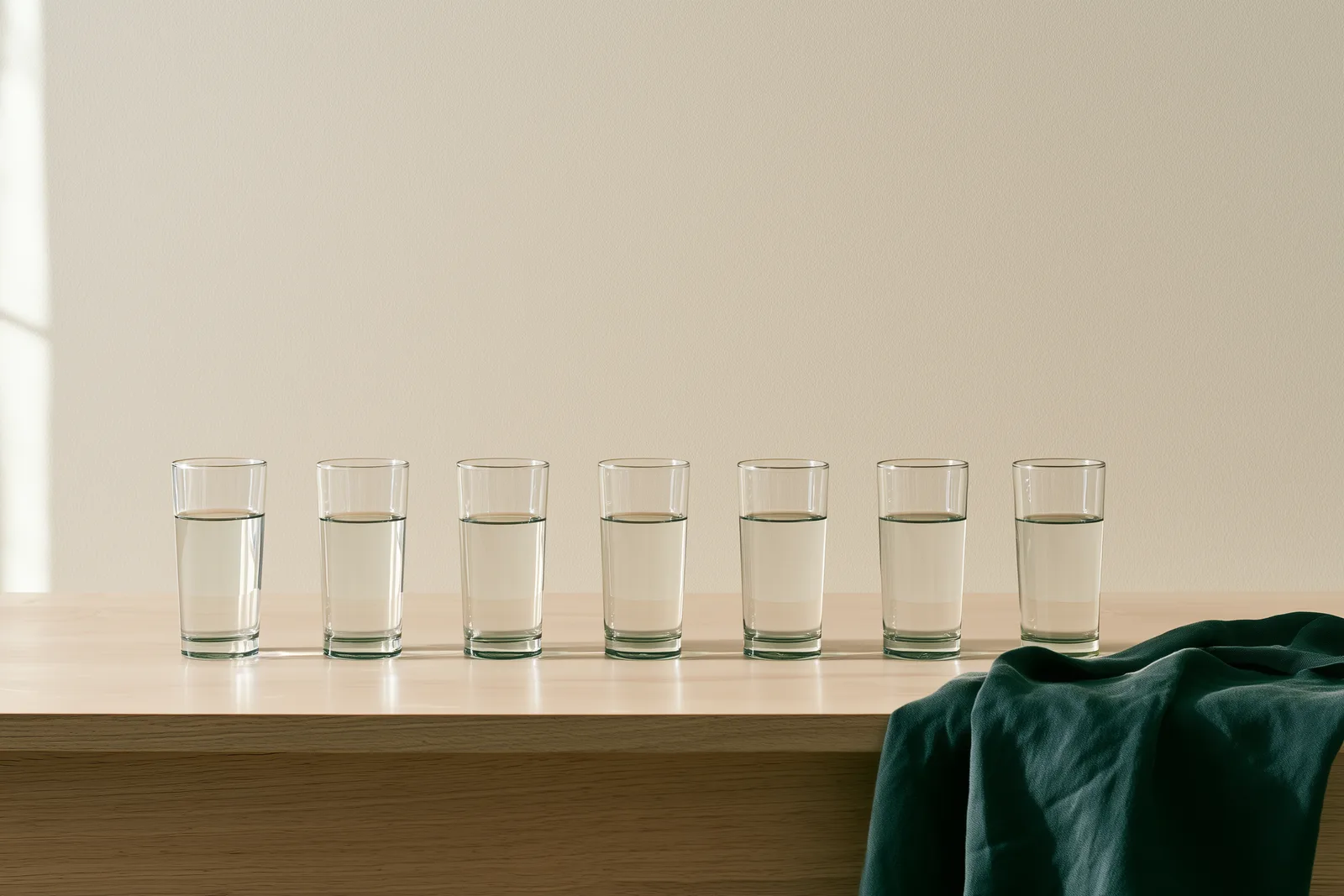
Seven identical glasses of water in a precise row, each catching the same morning light
Seven identical glasses — a week of the same daily rhythm.

That is quietly good news, because regularity is the dial you actually control. You cannot will yourself into deep sleep. You can get up at the same time — and it is wake time, not bedtime, that the body clock sets itself by.

It is also the dial nobody measures. Most people can tell you roughly how many hours they sleep; almost no one can tell you how much their bedtime drifted this month. A record fixes that. Vivledia shows your sleep regularity, not just your hours, alongside the rest of your habits — the same reason tracking beats willpower everywhere else in slow aging.

When is poor sleep a medical problem, not a habit?

Some sleep problems are not fixed by schedules. Talk to a clinician, rather than trying harder, if you have:

Sleep apnea in particular is common, underdiagnosed, and treatable.

For everyone else, the starting point costs nothing. Write down two times a day: when you went to bed, when you got up. A month of that will show you your own regularity — the dial you can actually move, and the one you have probably never seen.


Further Reading

_This article is for general information and is not medical advice. It is not intended to diagnose, treat, cure, or prevent any disease. Talk to a licensed clinician about your own situation, especially if you suspect a sleep disorder or before making significant changes to medication or daily routines._


Frequently asked questions

How much sleep do adults need?

The mortality data converges on 7 to 8 hours a night for most adults, and risk rises at both ends. But this is a population curve, not a prescription — individual needs vary. A more useful personal test is whether you wake near your usual time without an alarm and stay alert through the day. If you need much more than nine hours to manage that, or feel exhausted despite enough hours, that is worth discussing with a clinician.

Does sleep regularity matter more than duration?

They are two separate dials, and the larger data sets suggest regularity is the stronger one. In 60,977 UK Biobank adults whose sleep was recorded by accelerometer, regularity predicted all-cause mortality better than duration did, and the association held after adjusting for how long people slept. Regularity is also the easier dial to act on: you can choose when you get up. Almost nobody knows how far their own schedule drifts, which is why it is worth recording.

Why do older adults sleep less?

Sleep architecture changes with age — deep sleep declines from midlife onward, awakenings become more frequent, and sleep gets lighter and more fragmented. Some of that shift is expected. What is not expected is feeling wrecked by it — age explains lighter sleep, not exhaustion, and that difference is worth raising with a clinician rather than accepting poor sleep as inevitable.

Can I catch up on sleep with naps or by sleeping in on weekends?

Partially at best. Naps can restore alertness for the afternoon, and extra weekend sleep repays some short-term debt. But shifting your schedule by hours on weekends is itself a form of irregularity — the same irregularity linked to higher mortality risk. A short early-afternoon nap on a stable schedule is a reasonable tool; using weekends to repair the week, repeated for years, is the pattern the data argues against.

Share X Reddit
References
  1. Cappuccio FP, D'Elia L, Strazzullo P, Miller MA. Sleep duration and all-cause mortality: a systematic review and meta-analysis of prospective studies. Sleep. 2010;33(5):585-592. PMID: 20469800
  2. Iliff JJ, et al. A paravascular pathway facilitates CSF flow through the brain parenchyma and the clearance of interstitial solutes, including amyloid β. Science Translational Medicine. 2012. PMID: 22896675
  3. Shokri-Kojori E, et al. β-Amyloid accumulation in the human brain after one night of sleep deprivation. PNAS. 2018;115(17):4483-4488. PMID: 29632177
  4. Iliff JJ, et al. The glymphatic system clears amyloid beta and tau from brain to plasma in humans. Nature Communications. 2026. PMID: 41593094
  5. Windred DP, et al. Sleep regularity is a stronger predictor of mortality risk than sleep duration: a prospective cohort study. Sleep. 2024;47(1):zsad253. PMID: 37738616
  6. Cribb L, Sha R, Yiallourou S, et al. Sleep regularity and mortality: a prospective analysis in the UK Biobank. eLife. 2023;12:RP88359. PMID: 37995126
  7. Centers for Disease Control and Prevention. Sleep duration among adults — Behavioral Risk Factor Surveillance System, United States, 2022.
This content is for general informational purposes only and is not medical advice. It is not intended to diagnose, treat, cure, or prevent any disease, and it is not a substitute for care from a qualified healthcare professional. Always consult your clinician about specific symptoms, conditions, or before changing medications.
Jay
Jaeyoung Ko, M.D.
M.D., Seoul National University College of Medicine

A physician trained at Seoul National University College of Medicine. Starting from the question of why health matters and what aging really is, he builds Vivledia — an app for logging daily health habits and managing the pace of aging.

Get the next one by email

New evidence-based pieces on slow aging, screenings, and nutrition — sent when they publish. No spam, no sharing your address, unsubscribe any time.

By subscribing you agree to receive occasional emails from us. We store only your address, and never sell or share it. See our Privacy Policy.

Your multivitamin has zinc. So does your zinc.

Photograph your labels — Vivledia totals every ingredient you take and flags what crosses the upper intake limit.

All insights© 2026 Vivledia